LeBron's sneakers since he signed with the 76ers: the same shoes sell for 5.6% less
Eleven weeks after LeBron James announced his move to Philadelphia, 88 of his shoes compared with themselves resell for a median 5.6% less than in the eleven weeks before. Every other shoe on GOAT and StockX moved 0.7%. His LeBron 23 colorways fell hardest; his retros slipped too; Ja Morant's line rose over the same weeks.
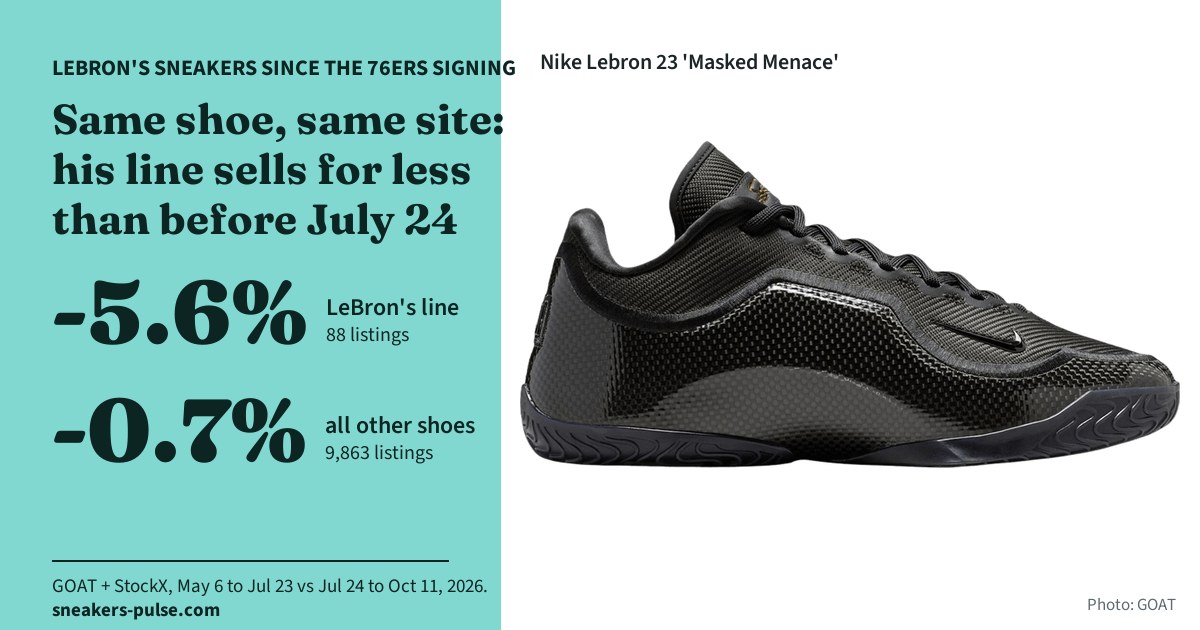
On Friday, July 24, 2026, LeBron James announced he was leaving the Lakers after eight seasons to sign a two-year deal with the Philadelphia 76ers (ABC News). A new city, a new jersey, a 24th season. The sneaker question followed within minutes: what does a move like that do to the price of his shoes? Not the hype, the sales. We have every completed resale sale on GOAT and StockX since October 2024, so we can answer it the boring way: the same shoe, on the same marketplace, before and after.
The answer is: his shoes sell for about 5.6% less than they did before the announcement. We took every LeBron listing with at least 15 sales in the eleven weeks before July 24 and at least 15 in the weeks after it, 88 listings in all, and compared each with itself. The median change is -5.6%, and the 95% interval runs from -7.3% to -2.0%. Fifty-eight of the 88 fell. Over the same windows, the 9,863 other sneaker listings on the two marketplaces moved -0.7%, with the interval from -0.9% to -0.4%. The gap between his line and everything else is not chance: it survives correction for the eight tests behind this post (q = 0.005, meaning well under a 1% chance of a false positive among them). What the data cannot say is that the move caused it. The timing lines up, and the comparison lines below rule out the obvious alternative, but a price series has no column for motive.
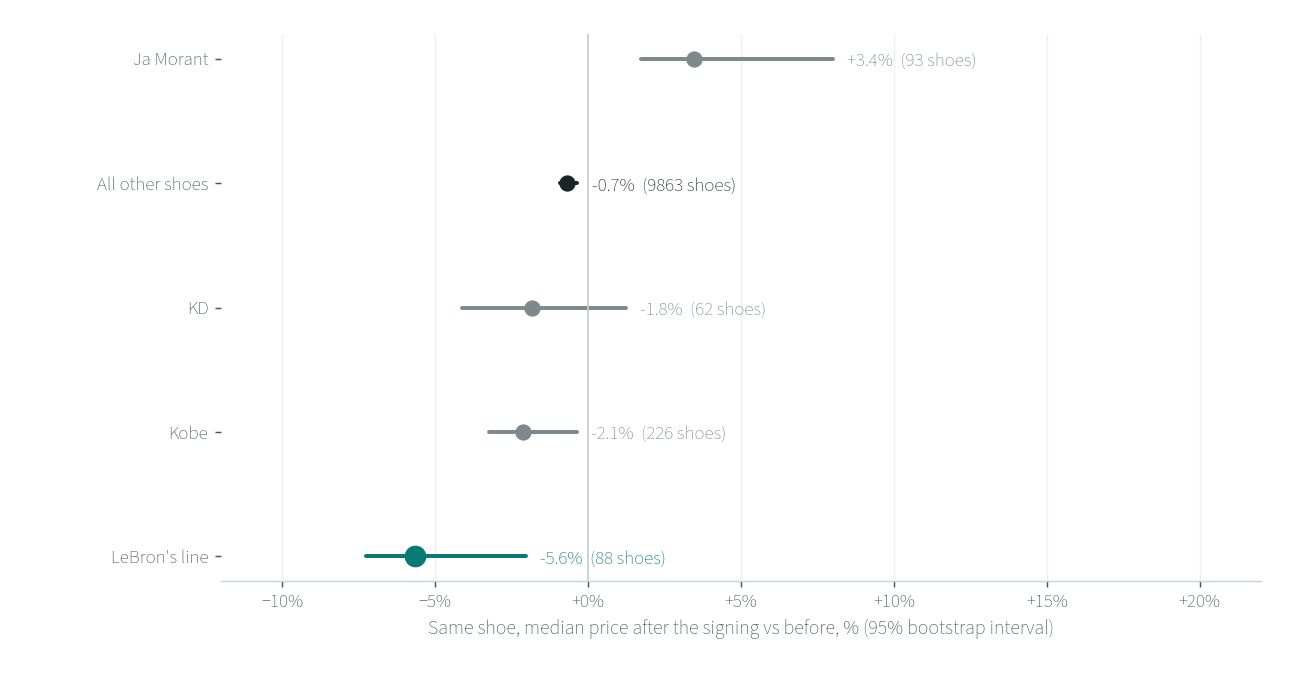
It is his line, not basketball shoes in general
The obvious objection is that performance basketball shoes slide every autumn as the new models land. So we ran the same comparison on three other signature lines over the same windows.
| Line | Listings compared | Median same-shoe change | 95% interval | Rose / fell |
|---|---|---|---|---|
| LeBron | 88 | -5.6% | -7.3% to -2.0% | 29 / 58 |
| Kobe | 226 | -2.1% | -3.2% to -0.4% | 91 / 130 |
| KD | 62 | -1.8% | -4.1% to +1.2% | 26 / 35 |
| Ja Morant | 93 | +3.4% | +1.7% to +8.0% | 59 / 29 |
| All other shoes | 9,863 | -0.7% | -0.9% to -0.4% | 4,392 / 5,067 |
Ja Morant's line went the other way, up 3.4%, and that rise is just as clear in the tests as LeBron's fall (q below 0.001). The Kobe line slipped 2.1%, which is a real move within the line (q = 0.017) but not one we can tell apart from the market as a whole (q = 0.16). KD is a null. So "basketball shoes got cheaper" does not explain it. LeBron's line fell on its own.
The LeBron 23 took most of the hit
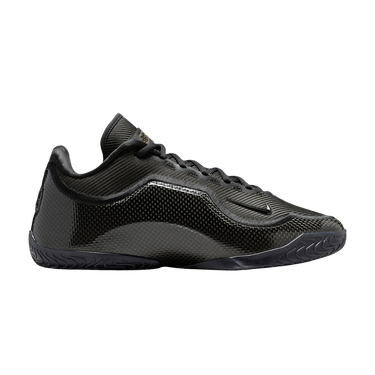
Within his line the drop is not even. His current signature shoe, the LeBron 23, is where the money came off: the 19 LeBron 23 colorways we could compare fell a median 13.4% (interval -20.5% to -6.7%). The Honor Society went from a $121 median to $72 on StockX, the Heat Wave from $116 to $78, the Miami Twice from $126 to $97 on GOAT, and the Masked Menace, the single most-sold LeBron 23 on GOAT, from $153 to $122.
One honest caveat on that number. The LeBron 23 colorways all released within the last year, and new shoes slide in their first months whoever is wearing them (the release slide, the price drop almost every new sneaker sees as the launch rush fades): the same shoe typically sold 14.4% lower twelve weeks after release in our release study. Part of the 23's fall is age, not Philadelphia.
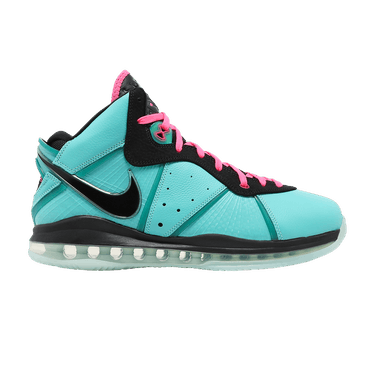
His retros cannot use that excuse. The 13 LeBron 7 to 19 retro listings we could compare fell a median 7.8% (interval -15.9% to 0.0%): the LeBron 8 'South Beach' 2021 went from $214 to $180 on StockX, the LeBron 9 'Big Bang' 2022 from $190 to $145. Those are shoes from 2010 and 2012, reissued years ago, with no release slide left in them. The NXXT Gen, his cheaper takedown model, held flat (+0.7% across 13 listings), and the LeBron 21 barely moved (-1.1% across 9).
The pairs that lost the most were the ones with his name and number on them right now. The pairs that held were the cheap ones and the ones nobody buys for the player.
What people actually buy from his line
Since the signing his line has sold 6,208 recorded pairs on the two marketplaces in the windows we trust (StockX through October 11, GOAT through September 20; see the note below). A quarter of them are retros.
| What sold | Share of his line's sales | Sales | Median price |
|---|---|---|---|
| LeBron 7 to 19 retros | 25% | 1,563 | $145 |
| Zoom LeBron NXXT Gen | 14% | 858 | $89 |
| LeBron 23 | 13% | 824 | $122 |
| LeBron 21 | 11% | 697 | $107 |
| LeBron 20 | 10% | 632 | $157 |
| LeBron Witness | 9% | 545 | $82 |
| LeBron 22 | 6% | 368 | $94 |
| Collabs on other Nikes (Dunk, Air Force 1, Air Max) | 4% | 256 | $138 |
| Other LeBron | 7% | 465 | $115 |
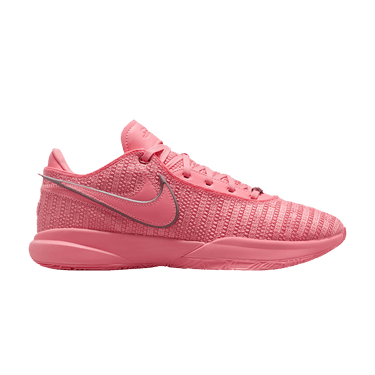
The single most-sold pair is not a LeBron 23 at all. It is the LeBron 20 'Pink Diamond', with 192 sales at a $190 median on StockX and $166 on GOAT, and it is one of the few that rose, from $177 to $190 on StockX. Then the NXXT Gen 'White' (172 sales, $108 on StockX and $125 on GOAT), the LeBron 8 'South Beach' 2021 (139 sales, $180 and $209), the LeBron 23 'Heat Wave' (113), the 'Masked Menace' (108, GOAT only) and the LeBron 21 'Prime 93' (108, $105 and $133).
A handful of pairs went up. The Witness 7 'Black Anthracite' went from $98 to $127 on StockX (54 then 23 sales), the LeBron 20 'Chosen 1' from $89 to $113 (20 then 17), and the LeBron 4 'Fruity Pebbles' 2024 from $150 to $185 (27 then 21). Small samples, so read them as "did not fall" rather than as a trend.
And the Lakers colorways? The LeBron 8 'Lakers' sold for a $111 median before the move and $112 after it on StockX, on 20 and then 14 sales. Too few pairs to call either way, and nothing in the data says Lakers purple got cheaper the week he left.
Why we waited a few hours to write this
When we first pulled the numbers on the morning of October 12, our record showed only 25 of his listings trading in the week of October 5, against about 300 a week in July. That would have been a sensational chart and a wrong one. The gap was in our own history fetch, which works through products in volume order and had not reached his lower-volume listings for weeks, not in the market. So before writing we refreshed every LeBron listing on both marketplaces against the feed (1,731 listings, 2,824 sales added), and re-ran the check. StockX now carries 80% to 100% of its summer listing count for his line in every week through October 11. GOAT's record of the line from September 21 still runs at 66% to 80% of its summer level even after that refresh, so for GOAT we stop at September 20 and we do not report a sales-volume trend for his line at all. Prices compare like with like whatever the coverage; volumes do not.
Past sales on GOAT and StockX, not a forecast, and nothing here is a reason to buy or sell a pair. If you own one of his shoes, the price checker shows what your exact colorway sold for in your size, and the where-to-sell tool shows which marketplace pays more after fees.
How we measured this
Sales: completed resale sales recorded on GOAT and StockX, footwear only (jerseys and apparel carrying his name excluded by name), prices $20 to $30,000. Windows: before = May 6 to July 23, 2026 (79 days); after = July 24 to October 11 on StockX and July 24 to September 20 on GOAT, the last weeks the backfill gate marks complete for his line on each marketplace (active listings per week at 80% or more of the line's own summer peak). Same-shoe method: each listing (one shoe on one marketplace) with 15 or more sales in both windows is compared with itself as the ratio of its median sale prices; a line's change is the median of those ratios with a seeded 2,000-draw bootstrap 95% interval. Tests: an exact two-sided sign test on rose versus fell within each line, and a Mann-Whitney test of each line's log ratios against the 9,863 other footwear listings; eight tests corrected together with Benjamini-Hochberg (LeBron sign q = 0.005, versus market q = 0.005; Ja Morant q = 0.005 and 0.0005; Kobe q = 0.017 and 0.16; KD q = 0.35 and 0.63). Family breakdown by listing name (LeBron 20 to 23 by number, NXXT Gen, Witness, retros 7 to 19, collabs on Dunk, Air Force 1 and Air Max). "What sold" counts every sale in the after windows, pooled across the two marketplaces; medians are per listing. Signing date from ABC News, July 24, 2026. Script: tools/blog_charts/2026-10-12-lebron-76ers.py; coverage check: tools/backfill_status.py.
Keep reading
 Air Jordan 12 'Bloodline' resale prices: fifteen weeks in, still what it launched atOctober 12, 2026 — 7 min read
 Caitlin Clark Kobe 5 and Kobe 6 Protro resale prices: above almost every other colorwayOctober 11, 2026 — 7 min read
 What are Space Jam sneakers worth? The old Jordan 11s resell for about 1.4x retailOctober 8, 2026 — 4 min read